
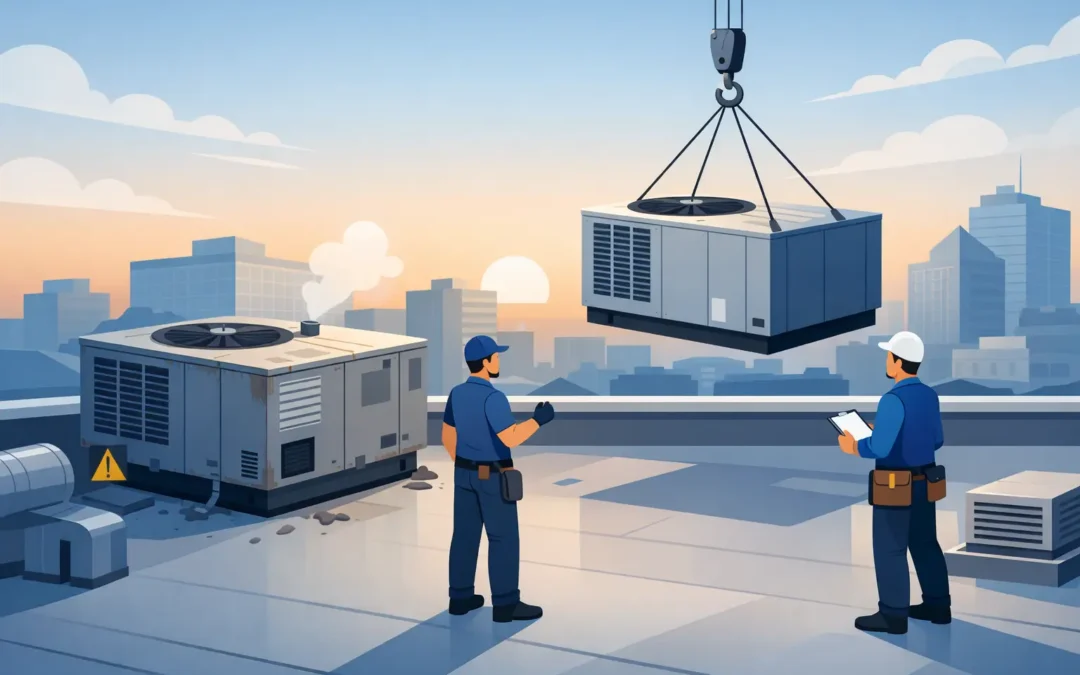
A failing RTU rarely picks a convenient time to quit. It usually shows up as rising repair invoices, uneven cooling across tenant spaces, humidity complaints, or a unit that keeps tripping calls during the hottest stretch of the year. If you are deciding when to replace commercial rooftop unit equipment, the right answer is usually not based on age alone. It comes down to risk, operating cost, building demands, and how much disruption you can afford.
For commercial property owners and facility teams, this is a capital planning decision as much as a mechanical one. Replacing too early can waste remaining asset life. Waiting too long can drive up emergency costs, disrupt tenants, and put strain on the rest of the property operation. The goal is to replace at the point where the numbers, the performance, and the building needs all point in the same direction.
When to replace commercial rooftop unit equipment
Most commercial rooftop units have an expected service life of roughly 12 to 20 years. In South Florida, that range can tighten because equipment works harder for longer periods and is exposed to heat, humidity, salt air, and storm conditions. A unit that looks acceptable on paper at year 15 may already be well past its practical replacement window if it has a history of compressor issues, corrosion, or control failures.
Age matters, but age without context is not enough. A 10-year-old unit with neglected maintenance and recurring breakdowns may be a better replacement candidate than a 17-year-old unit that has been consistently serviced and still performs efficiently. Facility managers should look at the full operating picture: repair frequency, energy use, part availability, comfort complaints, and whether the unit still matches the building’s current occupancy and load.
A good rule is this: if the unit is becoming unpredictable, expensive to keep online, or unable to maintain conditions reliably, replacement deserves serious review.
The warning signs that usually justify replacement
One major sign is repair frequency. If your team is calling for service several times a season, the issue is no longer just maintenance. Repeat failures often indicate broader wear across the system – compressors, condenser coils, blower motors, controls, or heat exchangers. Even if each repair seems manageable by itself, the cumulative cost and downtime can quickly exceed the value of extending the unit’s life.
Another clear indicator is declining performance. If some suites are comfortable while others stay warm, if humidity is creeping up indoors, or if the unit struggles to recover after business hours, that points to reduced capacity or internal inefficiency. For office, retail, medical, and industrial environments, inconsistent HVAC performance is not just an inconvenience. It affects tenant satisfaction, staff productivity, and in some cases compliance with indoor environment requirements.
Energy use also tells an important story. Older rooftop units typically operate at lower efficiency than current models, and that gap becomes more noticeable when run times are high. If utility costs have climbed without a clear operational reason, HVAC may be part of the problem. Replacement can lower energy consumption, but the savings depend on the unit size, controls, duct conditions, and how the building is actually used. It is worth evaluating, but it should be based on real load and operating data rather than assumptions.
Corrosion is another issue that deserves close attention in coastal markets. Rusted cabinets, coil deterioration, damaged drain pans, and compromised structural components often mean the unit is entering a stage where repairs become less reliable. Once corrosion affects key components, even a technically possible repair may not be the best long-term decision.
Repair or replace? The cost question
The repair-versus-replace decision is usually where owners want the clearest answer, but this is where context matters most. A single repair bill does not automatically justify replacement. A major repair on a relatively young unit can still make sense, especially if the rest of the equipment is in solid condition.
The equation changes when expensive repairs arrive late in the unit’s life. If an aging RTU needs a compressor, major control work, or repeated refrigerant-related service, you are often spending significant money to preserve an asset that may still underperform afterward. In those cases, replacement may offer more predictable operating costs and fewer interruptions.
There is also the hidden cost of failure to consider. Emergency service, after-hours labor, temporary cooling measures, tenant disruption, and reputation impact can all push the true cost of keeping an unreliable unit far beyond the invoice total. For occupied commercial buildings, that operational risk is often the deciding factor.
How building use affects the timeline
Not every property should replace on the same schedule. A small office with stable hours and low internal heat loads places different demands on a rooftop unit than a medical office, restaurant-adjacent retail space, or industrial facility with heat-generating equipment. Occupancy patterns, ventilation needs, and tenant expectations all affect how much strain the equipment is under.
That is why replacement timing should be tied to actual building demands. If a property has been renovated, re-tenanted, or reconfigured over the years, the original RTU may no longer be the right fit. An undersized unit will run harder and wear out faster. An oversized unit may short cycle, creating humidity and comfort problems while reducing efficiency.
In many cases, replacement is the right time to correct a sizing issue, upgrade controls, or improve zoning strategy. That approach protects the new investment and supports better building performance from day one.
Planning ahead prevents expensive downtime
One of the biggest mistakes in commercial HVAC is waiting until a unit fails completely before making a decision. Emergency replacements usually limit your options. You may have to accept whatever equipment is available fastest, work around weather exposure, and coordinate crane access or roof work on a compressed timeline. That often leads to higher costs and more disruption.
A planned replacement gives owners and facility managers more control. You can schedule around tenant activity, evaluate lead times, review energy performance, confirm curb and electrical requirements, and coordinate any related roof or structural considerations. On multi-site portfolios, planning also helps standardize equipment and simplify ongoing maintenance.
This is where working with a contractor that understands both mechanical systems and broader building conditions adds value. Rooftop unit replacement is rarely just about swapping a box. Roof penetrations, curb integrity, code updates, drainage, access, electrical service, and weatherproofing all need to be addressed correctly to protect the building and avoid follow-on issues.
Code compliance and system compatibility matter
Older equipment may predate current efficiency standards, control expectations, or ventilation requirements. Once you replace a commercial rooftop unit, the new installation needs to align with current code and site conditions. That can affect electrical upgrades, curb adapters, economizer requirements, smoke detectors, condensate management, and control integration.
This does not mean every replacement turns into a major redesign, but it does mean a proper assessment matters. If the existing unit has been patched repeatedly over time, there may be underlying issues with duct transitions, support conditions, or service access that should be corrected during replacement rather than carried forward.
A well-planned project should improve reliability without creating avoidable complications later. That includes documenting the installation, verifying startup performance, and making sure the new equipment can be maintained properly over its service life.
What a smart replacement decision looks like
The best replacement decisions are based on trend lines, not guesswork. Review the unit’s age, repair history, operating condition, energy performance, and the building’s current needs. If the RTU is approaching the end of its service life and showing multiple signs of decline, replacement is usually the safer financial decision.
If the unit is younger and the issue is isolated, repair may still be the better move. The key is to avoid making each decision in a vacuum. Looking at total cost of ownership gives a clearer picture than reacting to the latest service call.
For owners and managers responsible for uptime, tenant experience, and long-term asset value, the real question is not whether a rooftop unit can be repaired one more time. It is whether that repair still serves the building. When the equipment starts creating more risk than value, replacement is no longer a premature expense. It is sound facility planning.
If you are seeing repeated HVAC issues across a property, this is a good time to assess the full system before the next peak season forces your hand. A measured decision now usually costs less than a rushed one later.