
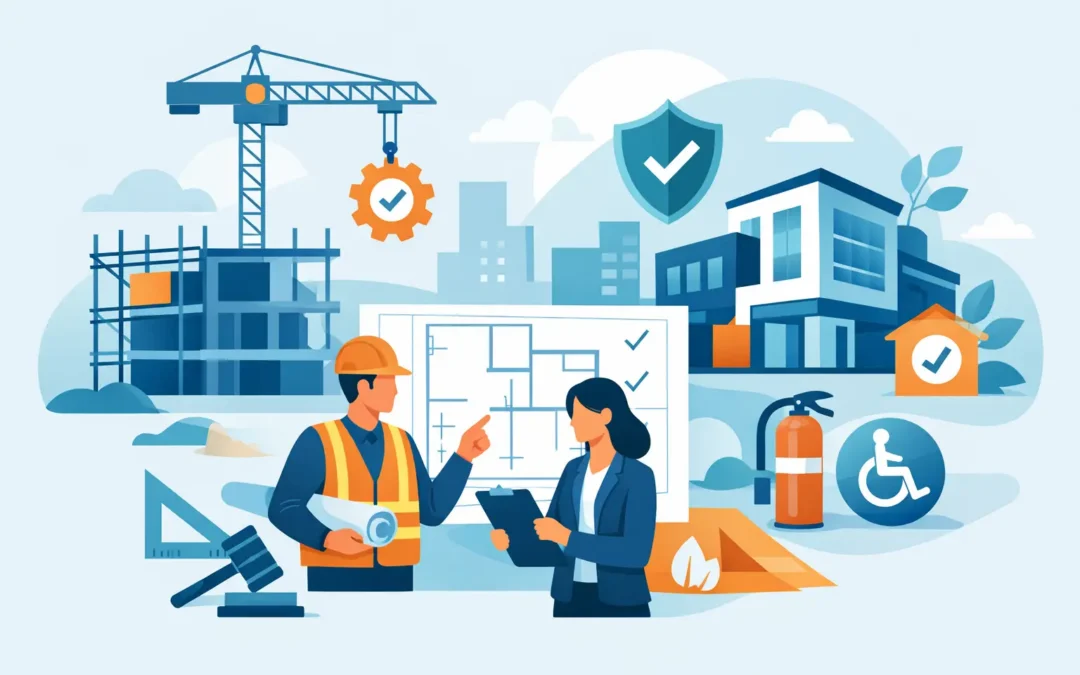
A failed inspection rarely starts as a major problem. More often, it starts with a rooftop unit replacement that was never fully permitted, an accessible path that no longer meets current requirements, or an electrical modification completed years ago without updated documentation. That is why building code compliance upgrades matter so much for commercial properties. They are not just about passing inspection. They protect occupancy, reduce liability, support insurance requirements, and help owners avoid larger capital costs later.
For property owners and facility managers, code compliance is rarely confined to one trade. A single upgrade can affect HVAC, electrical, fire life safety, accessibility, roofing, paving, structural elements, and interior build-outs at the same time. In active office, retail, medical, and industrial environments, the challenge is not only identifying what needs to be corrected. It is planning the work in a way that keeps operations moving, controls cost, and avoids repeat disruptions.
Why building code compliance upgrades become urgent
In many cases, compliance work becomes necessary after a trigger event. A property changes use, a tenant improvement project expands scope, a municipality cites deficiencies, or an insurer raises concerns during renewal. Deferred maintenance can also create code issues indirectly. When older systems fail and need replacement, the new work often has to meet current code, even if the original installation was legal when it was built.
South Florida properties face a particularly demanding environment. High humidity, salt exposure, storm risk, and heavy year-round use can accelerate wear on building systems and site features. That means compliance is not a one-time box to check. It is part of protecting the building as an operating asset.
What makes this difficult is that code upgrades are not always obvious during budgeting. An owner may expect to replace damaged concrete at an entry, then learn the repair also affects slope, handrails, striping, and accessible access routes. A simple HVAC replacement may require updated supports, disconnects, curbs, controls, or roof coordination. The cost is not just in the deficiency itself. It is in the connected work needed to bring the whole condition into compliance.
Where compliance gaps usually appear
Most commercial properties do not have one dramatic code problem. They have a collection of smaller issues that build up over time. Those gaps often show up in areas that have been modified repeatedly, maintained inconsistently, or exposed to changing occupancy demands.
Life safety and egress
Exit paths, emergency lighting, door hardware, fire-rated separations, and signage are common problem areas. These are easy to overlook because they sit in plain sight and may seem functional. But code focuses on whether those systems perform under emergency conditions, not whether they look acceptable during normal operations.
Accessibility and site conditions
Parking layouts, curb ramps, walkway slopes, entry thresholds, restroom fixtures, and service counters often create compliance issues. These problems are especially common in older shopping centers, office buildings, and mixed-use properties where partial renovations happened over time without a full review of the accessible route.
Mechanical, electrical, and plumbing updates
Equipment replacements can trigger current code requirements related to clearances, shutoffs, ventilation, supports, energy performance, and controls. If work was completed in stages over several years, documentation gaps can become just as serious as physical deficiencies.
Exterior envelope and structural components
Roofing, wall penetrations, drainage, guardrails, stairs, concrete deterioration, and masonry repairs may all intersect with code. In coastal markets, weather exposure increases the risk that what begins as maintenance turns into a compliance issue tied to safety or structural performance.
The real cost of delaying upgrades
Property stakeholders usually do not resist compliance work because they disagree with it. They delay it because they are managing competing priorities. Tenant demands, vacancy pressure, operating costs, and capital planning all pull from the same budget. Still, postponing code-driven work tends to become more expensive than addressing it early.
The first cost is operational risk. If a cited issue affects occupancy, fire safety, or accessibility, it can interfere with leasing, renewals, inspections, and day-to-day use. The second cost is project inefficiency. When compliance work is handled reactively, contractors often have to mobilize quickly, work around active deficiencies, and sequence trades under pressure. That usually means higher cost and more disruption.
There is also a reputational cost. Tenants, visitors, patients, and employees notice when a building feels neglected or inconsistent. Even when they cannot identify a specific code issue, they can see cracked approaches, damaged rails, poor lighting, or patched repairs. Those conditions affect confidence in the property.
How to approach building code compliance upgrades strategically
The most effective approach starts before a notice of violation or failed inspection. Owners and facility managers benefit from looking at compliance the same way they look at asset protection: as a planning function, not just a repair function.
A practical first step is to evaluate buildings by risk and visibility. Life safety issues and public-facing conditions should move to the top of the list. So should deficiencies that may expand in scope if left alone, such as failing concrete, drainage problems, or aging mechanical systems. Not every issue needs immediate correction, but every issue should be understood in terms of consequence, timing, and related trade impacts.
Documentation matters just as much as field conditions. Permits, closeout records, inspection reports, maintenance history, and as-built information help determine whether a building has a true deficiency or just an incomplete paper trail. Both matter. Municipalities, insurers, and future buyers may require proof that systems were installed and maintained correctly.
It also helps to package related work together. If an owner already plans to replace rooftop equipment, improve paving, renovate common areas, or update a façade, that is often the right time to address connected compliance items. Combining scopes can reduce downtime, avoid duplicate mobilization, and create a cleaner result.
Why single-source execution often works better
Building code compliance upgrades rarely stay within one trade. A corrected entry sequence may involve concrete, striping, signage, doors, lighting, and masonry. A back-of-house upgrade may involve HVAC, electrical, roofing, and structural supports. When multiple contractors work independently, the owner carries the coordination burden and the risk of gaps between scopes.
That is where a single-source contractor model can create real value. With broader trade coverage and construction management under one roof, coordination improves, schedule conflicts are reduced, and accountability is clearer. For occupied commercial properties, that matters. The goal is not just to complete the work. The goal is to complete it with minimal disruption and without creating new problems in adjacent systems.
This is especially relevant for multi-site owners and managers. Standardizing how compliance issues are identified, priced, scheduled, and documented can save time across a portfolio. It also gives stakeholders a more accurate view of recurring risks and capital needs.
What good compliance work looks like
Well-executed compliance upgrades do not feel like patchwork. They solve the immediate issue, align with current requirements, and support the long-term condition of the property. That means materials should be selected for durability, not just minimum acceptance. It means repairs should account for drainage, traffic, weather exposure, and maintenance access. It also means communication should be clear from start to finish.
For owners, the right contractor is not just someone who can perform the repair. It is a partner who understands how commercial properties operate, how local enforcement affects schedules, and how to coordinate improvements across building systems. Nexscope Services works in that space every day, helping commercial clients manage repairs, upgrades, and capital projects with a focus on quality, safety, and compliance.
There is no single formula for code-related work because every property has a different history, occupancy profile, and budget reality. Some projects call for immediate correction. Others need phased planning tied to lease events or capital cycles. The key is to treat compliance as part of disciplined property management rather than an interruption to it.
When a building stays ahead of code issues, it is easier to maintain tenant confidence, protect insurability, and preserve asset value. And when upgrades are planned with the right scope and execution strategy, they stop feeling like forced expenses and start functioning the way they should – as smart investments in the life of the property.