
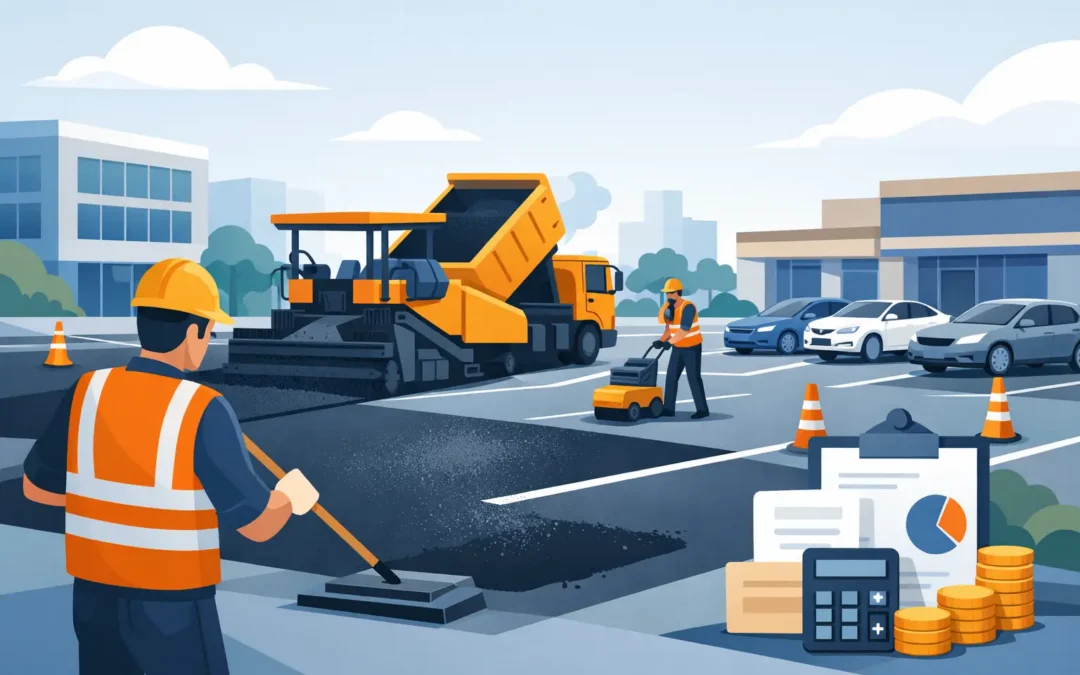
If a parking lot is starting to ravel, fade, or hold water after every rain, the question usually comes fast: what is the commercial parking lot resurfacing cost, and is resurfacing enough or is full replacement closer than it looks? For property owners and facility teams, that answer affects more than pavement. It affects tenant access, safety exposure, curb appeal, and how long the asset will perform before larger capital work is unavoidable.
For most commercial properties, resurfacing is the middle-ground option. It is typically more affordable than reconstruction, but it only makes sense when the existing pavement still has a stable base and the right structural conditions. The cost can vary widely based on the lot size, the amount of prep required, drainage issues, striping scope, and whether the work needs to be phased around active operations.
What commercial parking lot resurfacing cost usually includes
Resurfacing is not just laying a fresh layer of asphalt over an old lot. A quality scope starts with evaluating the current condition of the pavement, identifying failed areas, correcting localized issues, and preparing the surface so the new overlay bonds and performs as expected.
In practical terms, the commercial parking lot resurfacing cost often includes cleaning, edge preparation, crack treatment, patching in deteriorated sections, leveling low spots where possible, applying a tack coat when appropriate, installing a new asphalt overlay, and restriping the finished lot. On some projects, signage adjustments, wheel stop resets, ADA layout updates, and traffic control are also part of the budget.
That matters because two resurfacing proposals can look similar on paper and still be very different in value. A lower number may exclude corrective work that directly affects lifespan. A higher number may reflect more complete preparation, better traffic planning, or a thicker overlay designed for heavier vehicle loads.
Typical cost ranges for commercial resurfacing
Most commercial resurfacing projects are priced by the square foot, although some contractors may also price smaller jobs by the ton or by total scope. In many markets, resurfacing can fall roughly in the range of $2 to $5 per square foot. For more demanding commercial sites, especially those with extensive patching, drainage correction, traffic control needs, or after-hours scheduling, costs can move higher.
That means a 20,000-square-foot parking lot might land somewhere around $40,000 to $100,000 for resurfacing, depending on condition and scope. A straightforward office lot with light traffic and minimal repairs will price differently than a retail center with constant vehicle turnover, delivery activity, and multiple access points that must stay open during construction.
In South Florida, local conditions can also influence pricing. Heat, heavy rain, drainage challenges, and the need to maintain safe access for tenants and customers all shape how the work is planned. When contractors build those operational realities into the project, the number may be higher upfront, but the execution is usually stronger and the disruption is easier to manage.
The biggest cost drivers
Existing pavement condition
Condition is usually the biggest variable. If the asphalt has minor surface aging, some cracks, and isolated low spots, resurfacing is often a clean fit. If there is widespread alligator cracking, base failure, severe settlement, or recurring drainage problems, more extensive repair may be needed before any overlay is installed.
This is where pricing can shift quickly. A lot that looks worn from a distance may actually need full-depth patching in key sections, milling around transitions, or partial reconstruction at entrances and loading areas. Those repairs add cost, but skipping them usually shortens the life of the resurfacing work.
Lot size and layout
Larger lots can benefit from economies of scale, but layout still matters. A wide-open industrial yard is different from a medical office lot with islands, tight circulation routes, curb constraints, and pedestrian-sensitive areas. The more detailed the layout, the more labor and coordination are involved.
Properties that require phased access tend to cost more as well. If businesses must remain open, work may need to happen in sections, overnight, or on weekends. That can be the right decision operationally, but it usually changes labor efficiency and equipment sequencing.
Asphalt overlay thickness
Overlay thickness affects both price and performance. A thinner overlay may work in the right conditions, particularly where the lot has a sound structure and light traffic. Heavier-use properties often need a thicker section to stand up to turning loads, delivery vehicles, or constant circulation.
This is one of the most important trade-offs in resurfacing. A lower-cost overlay can reduce immediate spend, but if thickness is not aligned with site use, the pavement may show distress much sooner than expected.
Milling and leveling work
Not every lot can take a simple overlay. If there are elevation issues at curbs, sidewalks, catch basins, garage thresholds, or building entrances, the contractor may need to mill the existing surface first. Milling removes part of the old asphalt to create proper transitions and maintain drainage.
That added step improves the finished result, but it increases cost. It is often necessary for commercial sites where ADA accessibility, water flow, and finished elevation tolerances matter.
Drainage and water management
Standing water is one of the fastest ways to shorten pavement life. If resurfacing is being considered because the lot ponds after storms, the real issue may not be the surface alone. It may be slope loss, depressed areas, clogged structures, or deeper base movement.
Some drainage corrections can be handled within a resurfacing project. Others require more targeted reconstruction. Either way, solving water problems during the work is usually more cost-effective than resurfacing over them and dealing with premature deterioration later.
Striping, markings, and compliance updates
Once new asphalt is installed, the lot needs to be restriped. That includes stalls, directional arrows, fire lanes, crosswalks, loading zones, and ADA spaces. If the existing layout is outdated or noncompliant, resurfacing is the right time to correct it.
This part of the project is not usually the largest cost component, but it is essential. The finished lot should not only look clean – it should function better, move traffic clearly, and meet current site requirements.
When resurfacing makes sense and when it does not
Resurfacing makes sense when the pavement has surface wear but retains structural integrity. It is often a smart choice for office properties, retail centers, medical buildings, and light industrial sites that need a refreshed surface and improved appearance without the cost of full replacement.
It is not the right answer for every lot. If the sub-base has failed, the asphalt is breaking apart across large sections, or drainage defects are severe, resurfacing can become a short-term cosmetic fix. In those cases, spending less today may lead to spending more much sooner.
A dependable contractor should be willing to tell you when resurfacing is not enough. That kind of guidance protects the asset, even if it means a more complex conversation upfront.
How to budget more accurately
The best budgets start with a site-specific evaluation, not a generic square-foot estimate. Photos and rough measurements can help with early planning, but they do not replace a field review of surface distress, drainage, traffic patterns, and access constraints.
It also helps to define your operational priorities before pricing is finalized. If the property needs to stay open during business hours, if tenant access is sensitive, or if the work must be coordinated around deliveries or patient traffic, those factors should be built into the scope from the beginning.
For owners and managers with multiple capital needs, resurfacing can also be timed strategically. Bundling pavement work with concrete repairs, drainage improvements, signage updates, or other exterior upgrades can reduce mobilization inefficiencies and simplify vendor coordination. That is one reason many commercial clients prefer a single source partner with broader site improvement capabilities, such as Nexscope Services.
What a lower bid may be missing
Not every resurfacing estimate is measuring the same work. One proposal may include full cleaning, patching, milling at transitions, proper tack application, traffic maintenance, and compliant restriping. Another may leave out several of those items and still look competitive at first glance.
The real comparison is not just price. It is preparation quality, scope clarity, material assumptions, phasing plan, and expected service life. A lower number that leads to edge failure, reflective cracking, or water problems in a short window is rarely the less expensive option over time.
A better question than cost alone
Commercial parking lot resurfacing cost matters, but the more useful question is what you are buying for that cost: a short-term surface refresh, or a well-executed improvement that protects the property and supports operations for years. The right scope balances budget, pavement condition, tenant needs, and long-term asset performance.
If your lot is showing age, now is the right time to assess it before minor wear turns into structural failure. A clear evaluation and a realistic scope will usually save more than chasing the lowest number after the damage is already visible.